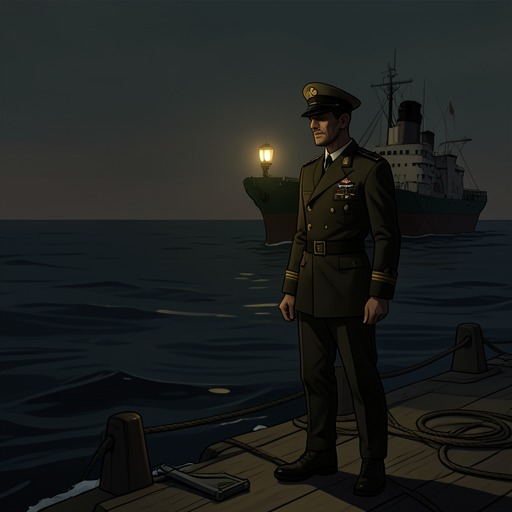
“No Christian charity in the North Atlantic”
The Good Shepherd“No Christian charity in the North Atlantic” is the expression that crystallizes Krause’s rescue dilemma: in a submarine-threatened convoy, mercy is not separate from operational risk, but neither can the lives of survivors be reduced to a calculation without consequence. Its sharpest meaning comes from the contradiction between the bleak rule it voices and the rescue order that follows.
The Phrase in the Rescue Dilemma
A survivor cries out from the dark water near Keeling, among the wreckage of a ship that has just exploded. The men may have escaped the flames on a raft, but the cold could kill them within minutes. Cadena is a mile away; alerting her would require Keeling to approach and hail her, and bringing her back could expose the rescue ship to a submarine within torpedo range. Krause weighs whether Cadena is worth risking for one or several lives, then whether Keeling should attempt the rescue herself.
The thought “There was no Christian charity in the North Atlantic” gives this calculation its most severe formulation. Krause considers the lives of Keeling and her crew worth a thousand merchant seamen’s lives, perhaps two thousand, and recognizes that saving the survivors would imperil his own ship. But the decision has costs beyond immediate tactical danger: the crew would eventually learn that Keeling had passed the survivors by, and that knowledge could damage their regard for their captain. Rescue might also strengthen Allied solidarity. The phrase thus marks not an absence of moral feeling but the pressure of incompatible responsibilities: protect the escort and the convoy, or take a risk for people who may otherwise freeze.
The Phrase Against the Action
Krause does not let the bleak maxim settle the matter. He orders right full rudder and asks for a course that will bring Keeling back to the spot. He then orders the engines ahead at one-third speed, setting the ship to make six knots. The return is a deliberate response to the danger, not an assumption that danger has vanished: the submarine threat remains part of the choice.
The narrative likens the speed of the order to a fencer’s foil circling to meet a disengage and lunge. A hundred peacetime man-overboard exercises have prepared Krause to grasp the difficulty and act instantly. That comparison makes the rescue order seem both practiced and contested: training supplies the prompt action, while command requires him to accept the tactical exposure it creates. The expression’s moral severity is therefore undercut by the act that follows it. There may be no safe or uncomplicated charity in these waters, but Krause chooses to attempt one.
Command, Risk, and Human Limits
Elsewhere, Krause’s decisions show that protecting the crew includes conserving their capacity to act. Keeling is already in Condition Two, with battle stations largely manned and watertight integrity maintained. Calling general quarters would put every man at his post, disrupt the ship’s routine, and leave ordinary maintenance undone; fatigue and hunger would accumulate, and repeated alarms without an evident reason could make men slack in their duties. Full battle stations can be endured for hours, whereas Condition Two can be maintained for days. The distinction makes readiness a limited resource rather than an inexhaustible posture.
Krause later decides that there will be no routine general-quarters call during the watch: unless there is an emergency, the watch below can have a full four hours’ rest. New weapons and instruments, additional personnel, crowded living space, and too few trained ratings for three Condition Two watches have forced him to divide the ship’s company into four sections and use a watch-and-watch routine. This concern does not cancel the rescue dilemma; it clarifies the practical ethic behind it. Command means weighing immediate lives and dangers while preserving the people and organization on which future action depends. The expression endures as the stark limit of that ethic, not its final verdict.